

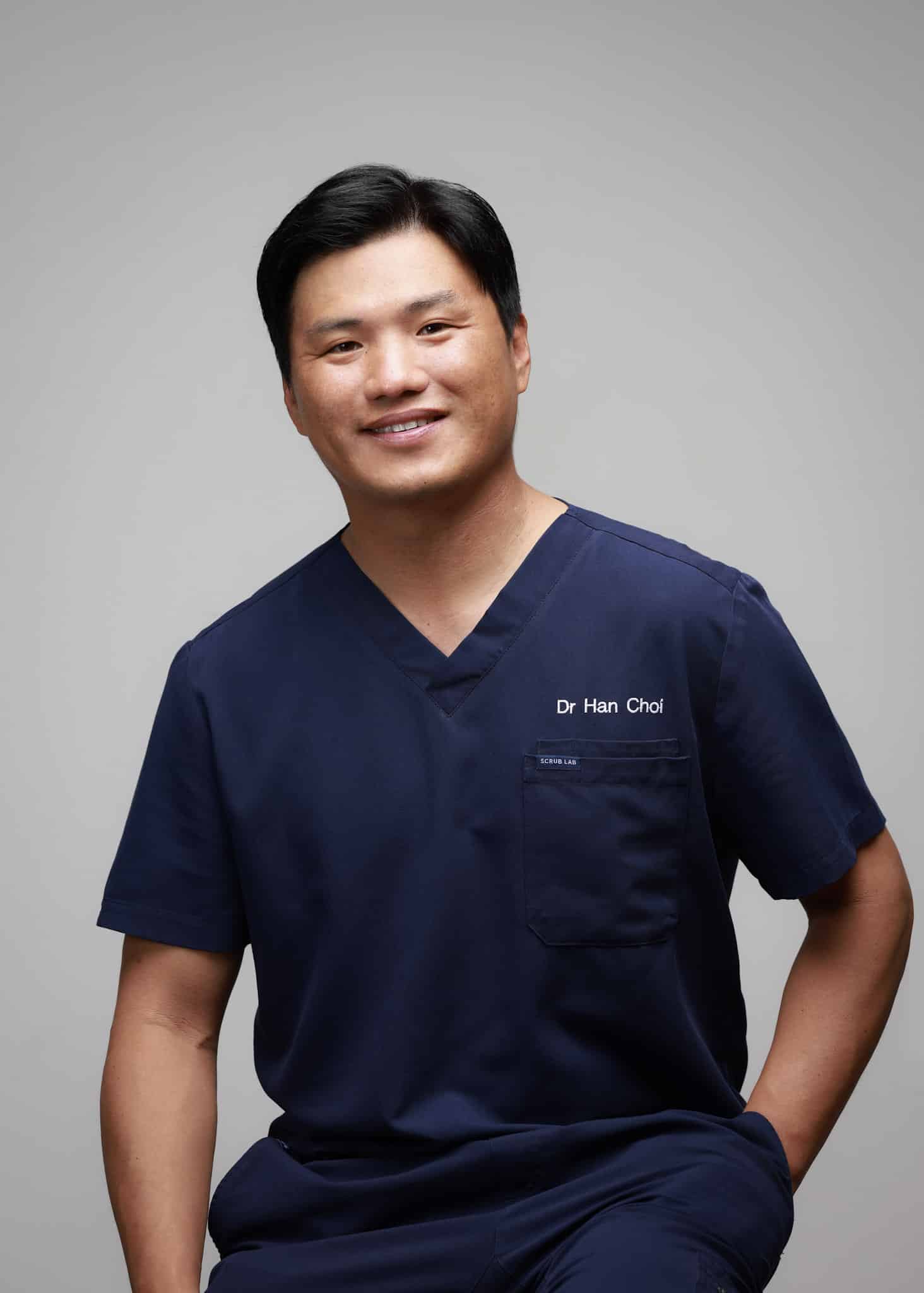
Hello, my name is Dr Han Choi and I am a Specialist Oral & Maxillofacial Surgeon. Oral & Maxillofacial Surgery is a unique speciality that requires both dental and medical training, followed by years of extensive surgical training. This makes us uniquely qualified to treat conditions, injuries, and defects of the mouth, face, and jaws.
My special interests are in full mouth implant rehabilitation (commonly known as All-on-4, All-on-6, or All-on-X), advanced bone and soft tissue grafting for dental implants, and the revision of complicated or failed implant treatments.
I was born in Korea and moved to New Zealand at the age of 13. After finishing high school in Auckland, I studied Dentistry (BDS) at the University of Otago. To pursue my goal of becoming an Oral & Maxillofacial Surgeon, I went on to complete Medicine (MBChB) and a Master’s in Oral & Maxillofacial Surgery with Distinction. My specialist training also included time at Dunedin, North Shore, and Middlemore Hospitals. I began my specialist career at NSOMS in 2012, where I continue to practice today. Over the years, I have also completed extensive overseas training in Europe and the USA, particularly in full mouth implant rehabilitation. This includes not only standard All-on-4 and All-on-6 procedures but also advanced solutions such as zygomatic, pterygoid, trans-nasal, and trans-sinus implants — options designed for patients with insufficient bone for conventional implants. I am now one of the most experienced clinicians in New Zealand in these advanced treatments.
Alongside full mouth implant rehabilitation, I provide comprehensive implant and implant-related surgical care, including complex dental implant treatment and all associated bone and soft tissue grafting procedures. I also enjoy performing wisdom tooth surgery.
Qualifications
This 53-year-old patient came to us after struggling with very loose teeth caused by advanced gum disease. Her biggest concern was improving her smile, and she also hoped to be able to eat comfortably again.
We removed the remaining teeth, placed four implants in both the upper and lower jaws, and provided her with a new fixed set of teeth. She is thrilled with her new smile and always expresses her appreciation whenever she returns for her annual check-up.
Full mouth implant rehabilitation is a life-changing treatment designed for patients who:
When planning for one or several dental implants, you may have been told that your jawbone volume is insufficient to support them.
Inadequate bone volume can occur for several reasons, including:
Vital structures such as the sinus or nerves being too close to the implant site.
Soft tissue is one of the most overlooked aspects of dental implant treatment. A successful dental implant requires the combination of four key elements:
To achieve long-term success and desired aesthetic outcome, we also need to optimise the biology so that the implant treatment is fully harmonised with the natural tissues of your mouth.
Unfortunately, implant treatment can sometimes fail. Studies show that the long-term failure rate of dental implants is approximately 5% over a 10-year period.
In my 13 years of private practice, and as I have treated more patients in recent years, I have seen many cases where implants have failed. This is especially challenging for patients who had their treatment done overseas, since they often cannot reach their original provider for follow-up or corrective care.
For full mouth implant rehabilitation, we can use remote anchorage implants (such as zygomatic, pterygoid, or trans-sinus implants) to provide stable support in patients with insufficient bone. Learn more. For partial cases, we can consider a range of bone grafting procedures to rebuild bone and allow implant placement. Learn more.
Yes. Full mouth implant rehabilitation is a major surgical procedure, typically lasting 2–4 hours. We recommend performing it under general anaesthesia (GA) in a medical-level operating theatre.
This ensures your safety and comfort, and removes variables such as movement, coughing, or fatigue which could compromise treatment outcomes. Our specialist anaesthetists are highly trained to provide both GA and IV sedation, allowing you to undergo surgery in the most comfortable and controlled way.
Yes. Revision surgery is possible, and this is one of our areas of special expertise. Learn more here
From start to finish, the process usually takes 3–6 months. This includes the surgery, placement of a temporary prosthesis, healing time, and then delivery of the final prosthesis. The temporary prosthesis is also fixed onto the implants and is typically provided within 1–3 days after surgery, so you will not experience a prolonged period without teeth.
The cost starts from $29,000 per arch. Fees are staged to align with each phase of treatment, and flexible payment options (including Q-Card finance) are available.
You will be fitted with a fixed temporary prosthesis within 1–3 days after surgery. While wearing this, you’ll need to follow a soft diet for 3–6 months to allow proper healing. Once your final prosthesis is placed, you can return to a normal diet.
Most patients need at least one week off work after surgery to rest and recover.
Maintenance depends on your oral hygiene routine and risk factors. Typically, we recommend visits every 6 months, but some patients may require annual reviews instead.
© 2026 | Dr Han Choi | All Rights reserved | Designed by 